In today’s environment, high-income professionals—especially those earning $200,000 to $300,000 or more—face a common challenge:
It’s not just about how much you earn… it’s about how much you keep after taxes.
Most individuals rely heavily on:
- Salary (fully taxable)
- 401(k) (tax-deferred, but taxable later)
What’s often missing is a third bucket: tax-advantaged or tax-free income.
This is where proper financial structuring becomes important.
The Concept of Tax Diversification
A well-structured financial plan typically includes three types of money:
- Taxable Income (salary, investments)
- Tax-Deferred Income (401k, IRA)
- Tax-Advantaged / Tax-Free Income
The goal is not to replace what you already have—but to add balance and flexibility for the future.
Where Indexed Universal Life (IUL) Fits In
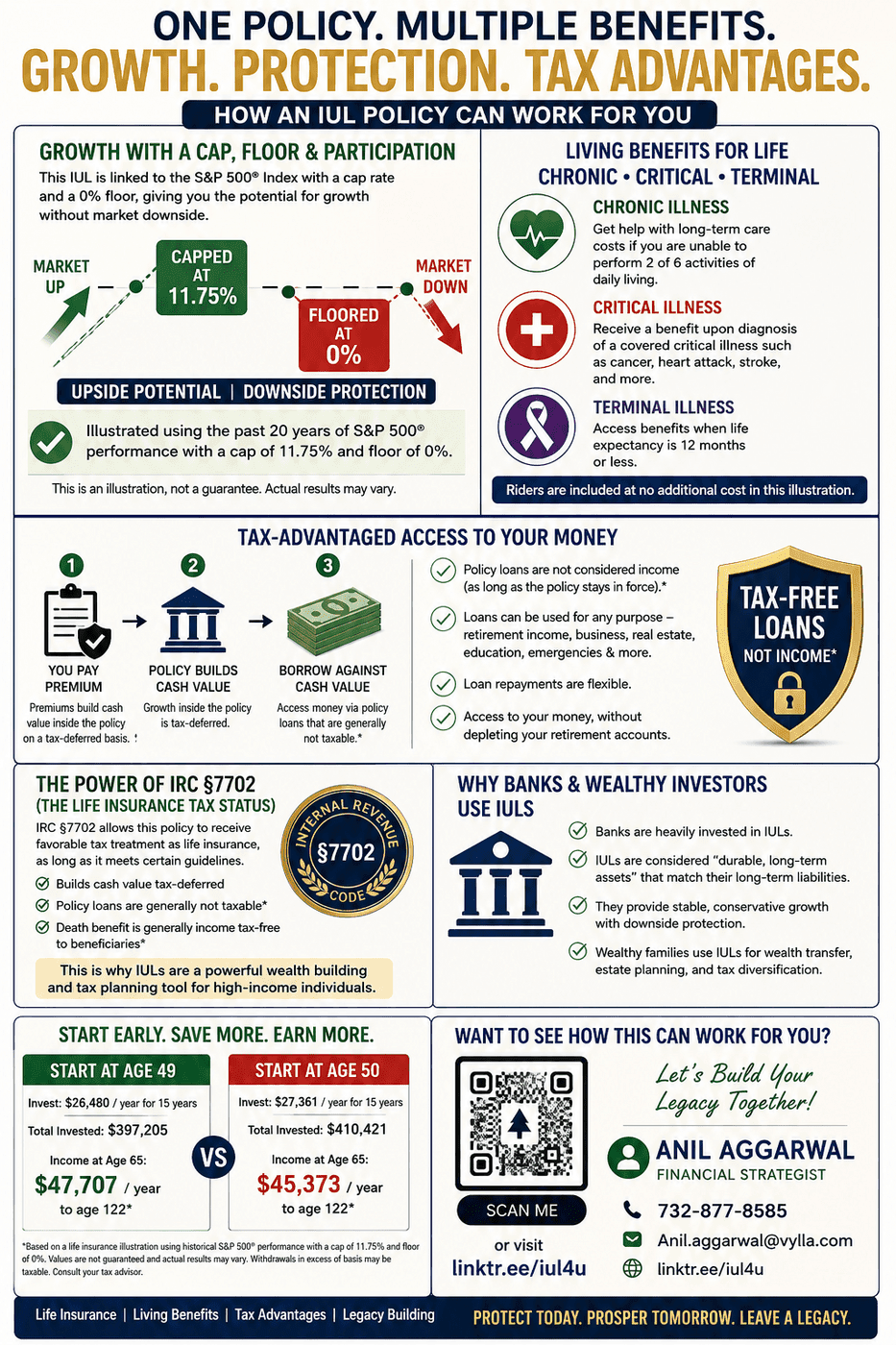
An Indexed Universal Life Insurance policy, when properly designed, can play a role in this third bucket.
It offers a combination of:
- Life insurance protection
- Potential for tax-deferred growth
- Access to funds in a tax-advantaged manner (if structured correctly)
- Market-linked growth with downside protection
Unlike traditional market investments, IUL policies are structured with:
- A floor (typically 0%) → protects against market losses
- A cap (maximum return limit) → limits upside but provides stability
Real Case Study: 29-Year-Old Client Strategy
Let’s look at a real-life example to understand how this works.
This policy was designed through Corebridge Financial using their ImperIUL Plus product.
Client Profile:
- Age: 29
- Gender: Female
- Health Class: Preferred Plus
- State: New Jersey
Policy Structure:
- Annual Contribution: $12,000
- Contribution Period: Up to age 60 (~31 years)
- Initial Death Benefit: ~$907,724
- Index Strategy: Linked to S&P 500 (not directly invested)
Key Feature:
- Cap Rate: ~11.75% (maximum upside)
- Floor: 0% (no loss in negative years)
How This Strategy Works Over Time
1. Early Years (Age 29–40)
- Focus is on building the foundation
- Cash value starts accumulating gradually
- Protection (life insurance) is fully active
For example:
- By age ~39, total contributions = ~$120,000
- Cash value begins to build meaningfully
2. Mid-Term Growth Phase (Age 40–60)
This is where compounding starts becoming powerful.
- Continued contributions of $12,000/year
- Market-linked growth (subject to cap and floor)
- Potential accumulation increases significantly
By age ~49:
- Contributions: ~$240,000
- Cash value shows strong growth potential
By age ~60:
- Total contributions: ~$360,000
- Cash value has grown substantially depending on market performance
3. Income & Access Phase (After Age 60)
At this stage, the policy may be structured to allow:
- Access to accumulated value
- Supplemental retirement income (via loans/withdrawals)
- Continued life insurance protection
This creates a flexible income stream that is not directly tied to market downturns.
Additional Benefit: Living Benefits
This policy also includes built-in living benefits, meaning:
If the insured faces:
- Critical illness
- Chronic illness
- Terminal illness
They may be able to access a portion of the death benefit early
This adds a layer of financial protection beyond traditional insurance.
Why This Strategy Works Well for Young Professionals
Starting at age 29 provides a major advantage:
1. Time in the Market
Longer duration = more compounding potential
2. Lower Cost of Insurance
Younger age = more efficient policy structure
3. Flexibility
Can adjust contributions or strategy over time
4. Tax Efficiency
Creates an additional bucket outside traditional retirement plans
Important Considerations
It’s important to understand:
- This is a long-term strategy, not a short-term investment
- Policy performance depends on multiple factors
- Values shown are based on assumptions and are not guaranteed
- Proper design and regular review are essential
Final Thoughts
For high-income individuals, especially younger professionals, the key question is:
“Will all my future income be taxable?”
If the answer is yes, it may be worth exploring strategies that introduce:
- Flexibility
- Protection
- Tax efficiency
An appropriately structured Indexed Universal Life policy can be one of the tools to help achieve that balance.
💰 Top 10 Legal Tax-Saving Strategies (H-1B, ~$300K Income)
1. Max Out Your 401(k)
- Contribute up to IRS limit (employee deferral + employer match if any)
- For 2026, expect ~$23K+ employee contribution (exact amount may adjust)
- Reduces taxable income immediately
👉 If employer allows Mega Backdoor Roth, even better (see #2)
2. Mega Backdoor Roth (if your plan allows)
- After-tax contributions → convert to Roth
- Can push total retirement contributions to ~$60K–$70K+
⚠️ Not all employers allow this—check your plan
3. Backdoor Roth IRA
- Since you earn too much for direct Roth:
- Contribute to Traditional IRA
- Convert to Roth IRA
✔️ Tax-free growth long term
⚠️ Watch pro-rata rule
4. Health Savings Account (HSA) – Triple Tax Advantage
If you have a high-deductible health plan:
- Tax deduction on contribution
- Tax-free growth
- Tax-free withdrawals for medical
👉 One of the best tax shelters in the US
5. Real Estate Depreciation Strategy
If you buy rental property:
- Use depreciation to offset rental income
- With proper structuring, can offset other income
💡 Advanced move: Cost segregation + bonus depreciation
6. Short-Term Rental (STR) Tax Strategy
(Airbnb model with active participation)
- Can offset W-2 income if structured correctly
- Works well for high earners
⚠️ Must meet IRS material participation rules
7. Donor-Advised Fund (DAF)
- Donate a large amount in one year
- Get immediate deduction
- Distribute to charities over time
👉 Great for years with high bonuses
8. Tax-Loss Harvesting
- Sell losing investments to offset gains
- Can deduct up to $3K against ordinary income annually
- Carry forward extra losses
9. 529 Plan Contributions (State Benefit)
- No federal deduction
- But some states give tax benefits
👉 Good if you plan kids’ education
10. Start a Side Business (Huge Opportunity)
Even on H-1B, limited options—but if spouse works or via proper structure:
- Business deductions (home office, travel, marketing)
- Solo 401(k) (if 1099 income exists)
⚠️ H-1B holders cannot freely run active businesses—must structure carefully
⚠️ Important H-1B-Specific Limitations
- You cannot actively work outside your sponsoring employer
- Passive income (stocks, real estate) is fine
- Active business = tricky → requires legal structuring
🔥 High-Impact Combo Strategy (What Most $300K Earners Do)
- Max 401(k)
- Backdoor Roth + Mega Backdoor
- HSA
- Real estate with depreciation
- Tax-loss harvesting
👉 This alone can save $20K–$80K+ annually
🧠 Pro Tip (Often Missed)
If you’re planning long-term in the U.S.:
- Consider transitioning to Green Card
- Opens up:
- Business ownership
- Advanced tax strategies
- More flexibility
👉 “Consult your tax advisor, I work alongside them”
me = strategist + implementer, not tax advisor